Agentic Commerce: everyone builds for the agent that leaves the store
The whole industry talks about the agent that takes the customer out of the store. Almost no one talks about the visitor who still lands on your site.
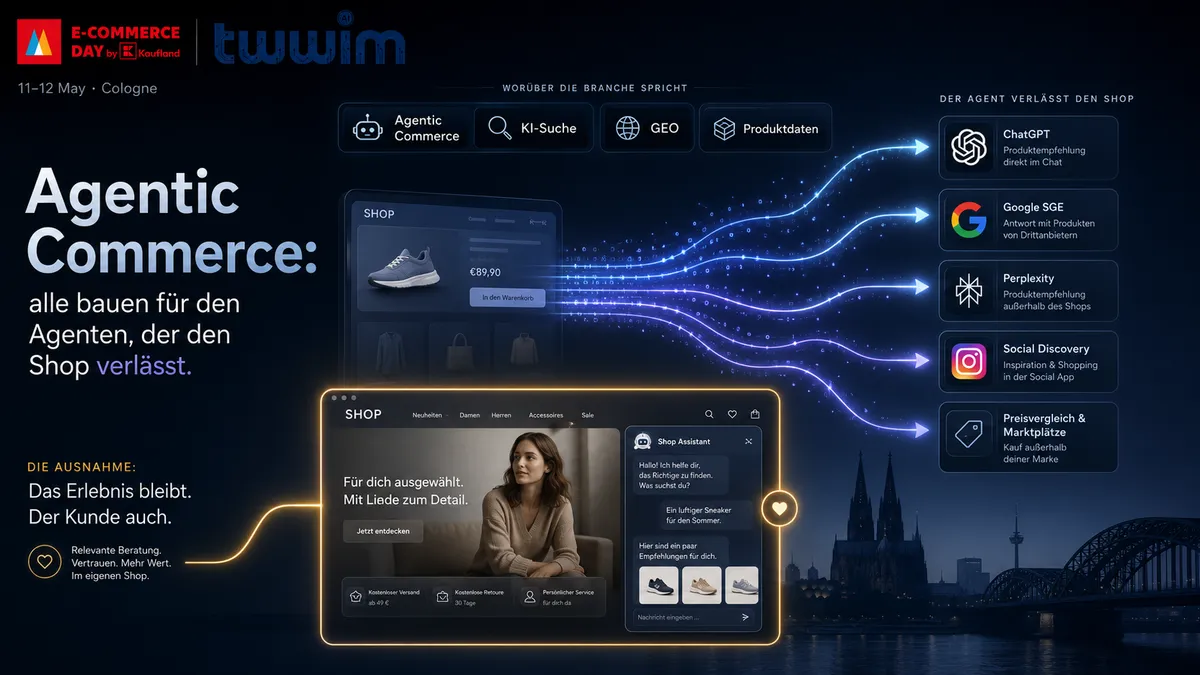
This week is e-Commerce Day in Cologne, and one evening I read through the agenda, talk by talk. What stays with you is a kind of background hum: agentic commerce, AI search, GEO, product data, in almost every other slot. And when you listen more closely, most of it is about the same character, the agent that takes the customer out of your store. The person who still lands on your site barely comes up. That is the more interesting part to me, and it is the one I want to write about here.
Where everyone is looking right now
The themes repeat, and that is not an accident, because they describe a real shift. Search no longer happens on your site but in ChatGPT, in Google AI Mode, or on Amazon. Visibility suddenly means showing up on as many marketplaces as possible at once, and if your product data is a mess, the agents find you less well. Even the brand gets rethought, as the "agent-friendly brand", in terms of how it looks when an AI buys on your customers' behalf. The talks are right about all of it, the feed becomes your business card, discovery moves outward, so far the consensus in the room. The thing is, this consensus always ends up describing the same movement, away from your site. The agent searches elsewhere, compares elsewhere, and at best buys elsewhere. That this is only half the story of agent commerce I wrote down at some length a while ago in The Fourth Layer, and this is exactly where the picture gets one-sided.
The most valuable visitor is often the one you do not see
Because the same AI wave also sends more people straight onto your site, and they are not just anyone. Adobe published US retail numbers on this in April, and they are fairly clear. Traffic from AI sources to American stores rose 393 percent year over year in the first quarter of 2026, and in March that traffic was about 42 percent more likely to convert than ordinary traffic, with revenue per visit 37 percent higher and almost half again as much time on site. A year ago a human visitor was worth more than twice an AI-referred one, and today that has flipped. Shopify reported something similar from its own platform in the spring, where AI shoppers convert about 50 percent better. These are US figures, and I am not selling them here as DACH numbers, but the direction is hard to ignore.
The real catch is somewhere else. Most stores do not see this visitor for what they are, because in GA4 and in many analytics setups they land under "direct" or "unassigned" the moment the referrer is missing. And direct is already the largest and blurriest bucket in the whole report. So the most valuable channel you currently have hides in exactly the place where no one looks closely.
A deep entry, a cold start
On top of that, there is how these visitors arrive in the first place, because an AI rarely sends someone neatly to your homepage. It drops them deep into the store, straight onto a product page, with no context, in the middle of a task. And the product page is the page least prepared for that person, in the same Adobe analysis around 34 percent of them were not even cleanly readable by AI. The common advice stays oddly passive: write better product descriptions, clean up your feed, get your pages read correctly by AI search. All of it correct, all of it important, so that you get found at all, but none of it helps the person who is already there and wants to get something done. They are standing on a single product page and would have to click their own way through the rest of the store to find what really fits. The old version of this was twelve categories and a bit of hope. That exact distinction, discoverable for agents versus usable for the person already there, I took apart using WordPress 7 in this post.
The layer I build for
This is exactly where I build, with TWWIM, and the principle is simple. TWWIM is an OnSite AI Agent: the visitor says or types what they want, and the agent acts right on the page instead of sending them off. It searches the catalog, sets filters, picks the variant, fills a form, and adds to cart, not only in a shop, but on any website, including a B2B or service site, embedded through a JS-snippet. It pulls product data straight from the store, on Shopify, WooCommerce, or JTL, instead of piecing it together from the page. What acting on the page instead of only answering feels like, I walked through with concrete examples in Answering and acting.
The second half matters to me just as much, and it comes down to trust. I know from experience that merchants in the DACH region do not believe an AI blindly, so you have to be able to see what it does. The dashboard shows exactly that, the actions the AI takes and what visitors are really looking for, from demand to the gaps in your range. It is basically the same gap as the one with traffic above, just from the other side, because you cannot improve what you cannot measure. All of it runs in the EU, built in Aachen.
On one point the e-Commerce Day agenda is completely right, AI is changing commerce at every step. It just tells one half of it loudly, the way out. The other half is the person who still lands on your site, more valuable than ever and worse served than they should be. Which half you build first is, in the end, a decision. I have made mine.
About the author: Dmitri Botezat is the founder of TWWIM (twwim.ai), an OnSite AI Agent for shops and websites. Built in Aachen, hosted in the EU.