WordPress 7.0 makes your shop discoverable for AI agents. Not usable for the visitor who is already there.
WordPress 7.0 ships May 20 with the JavaScript Abilities API and Connectors UI default-on. Roughly 4.7 million WooCommerce shops become AI-agent-discoverable within 30 days. The hype calls this "the AI step done." It is one axis of two, and the second one is where most conversion still leaks today.
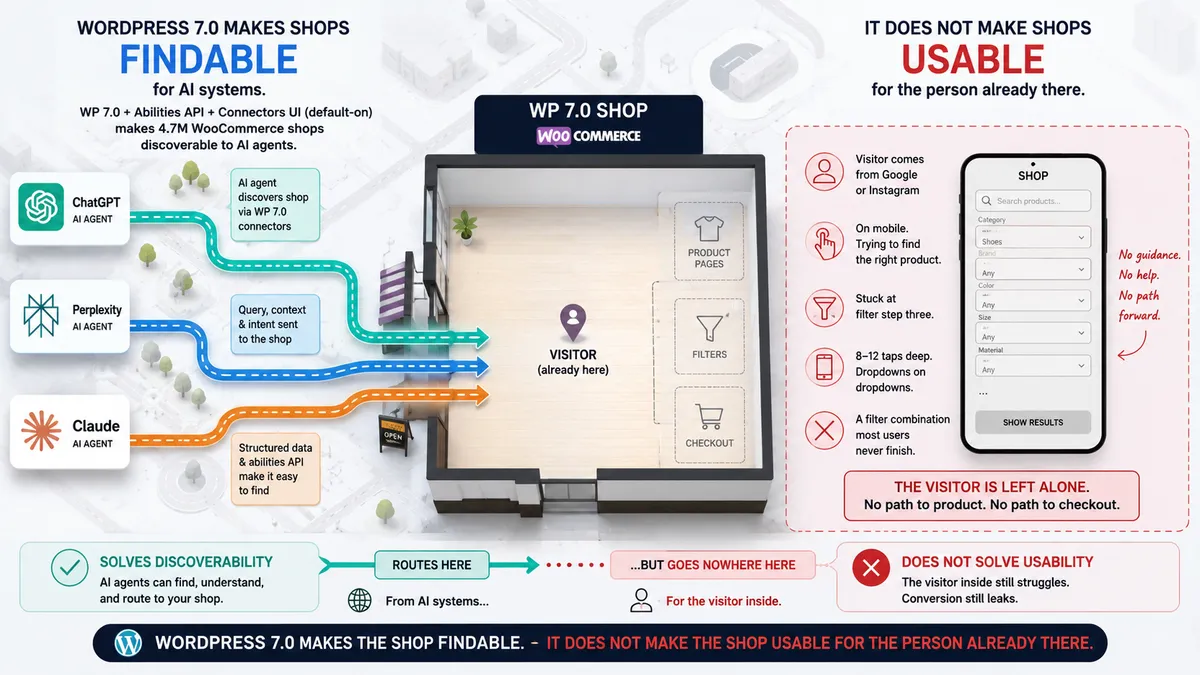
In six days, WordPress 7.0 ships. With it, the JavaScript Abilities API and the Connectors UI go default-on for every site running auto-update. WordPress.org tells us this reaches 43.5% of all websites, which means roughly 4.7 million WooCommerce stores become AI-agent-discoverable within 30 days of release. The release notes celebrate this. Many web agencies will mark it as "the AI step done" for their clients.
It is not.
What WordPress 7.0 actually adds
The Abilities API is a registry. Plugins, themes, and core declare named capabilities like create_order or list_products, each with structured input and output schemas. AI agents discover these capabilities and invoke them via PHP, REST, or WebMCP. The PHP version shipped in WordPress 6.9 back in January. The JavaScript counterpart ships May 20, locked after the delay from April 9.
WooCommerce parallels this work. WooCommerce 10.8 Beta released May 12 with GraphQL for agents and a leaner Store API. WooCommerce 10.9 will ship the first batch of canonical domain abilities. WooCommerce for Claude prebuilt workflows shipped the same day. Stripe Agentic Commerce Protocol integration is in production. The Universal Commerce Protocol coalition keeps adding members.
All of this is real. All of this matters. None of it solves the problem most shops actually have.
One axis well covered. The other still empty.
I wrote about this earlier this month in the Fourth Layer piece. Both ACP and UCP, and now WP 7.0 with the Abilities API, model the same case: an external agent comes to the shop. The customer talks to ChatGPT, Perplexity, Claude, Gemini, Copilot. The agent finds the product, fills the cart, processes checkout. The shop is the data source and the transaction endpoint. The customer never sees the storefront.
This is axis 1. WP 7.0 makes it default-on for WooCommerce.
There is a second axis. The customer arrives at the shop directly, because they followed an Instagram link, clicked a Google ad, remembered the brand. They are on the product page or the category page. They want to ask a question, set a filter, compare two items, complete a purchase. They do not want to learn the structure of your filters.
In most European shops, mobile traffic is 60 to 70 percent of visits. It converts at roughly one third of the desktop rate. Why? Not because the products are wrong. Because a typical filter combination on mobile takes 8 to 12 taps to construct, and most visitors do not finish.
WP 7.0 does nothing for this visitor. Neither does UCP, ACP, the Cloudflare Agent Readiness Score, the Shopify Catalog API, or any agentic commerce announcement of the last twelve months. All of them describe what happens when an agent shows up at your shop from outside. None of them describe what happens when a human shows up and needs help on the page.
Why the gap exists
The architecture of an external agent is one thing. The agent has a clear transactional goal: find, check, mandate, submit. Permissions are tight, state is short, the agent identifies the user through platform authentication.
An on-page agent that helps a human visitor works under different rules. It needs to see what is on the current page. It needs to react when filters update or products lazy-load. It needs continuity when the visitor returns next week. It needs to perform actions on the page itself, not against a backend API. Permissions, state, data flow, action model. All fundamentally different from the external case.
The Abilities API addresses the external case. It does not address the on-page case. There is no equivalent standard for what an on-page agent needs.
What WP 7.0 means in practice
For WooCommerce merchants: turn on the Connectors. The Abilities API will be active anyway via auto-update, but the Connectors UI lets you choose which channels to expose. ChatGPT, Perplexity, Claude. Opt in to what serves your audience. Audit your product data structure. Make sure your prices, availability, return windows, and shipping rules are clean and machine-readable. Effort: a few hours of engineering per shop.
The return is real but slow. Discovery in AI channels matters in 12 to 24 months. Today most consumers still arrive via Google, Instagram, direct, or app. WP 7.0 prepares you for tomorrow's traffic mix.
For the visitor you already have today on mobile: WP 7.0 changes nothing. Conversion still leaks at filter step three, at the size selector, at the form on checkout. Recovery emails do not solve this. They intervene after the abandonment.
For agencies serving WooCommerce clients in DACH: the case for accessibility tools, voice navigation, on-page AI assistants has not weakened with WP 7.0. It has strengthened. WP 7.0 confirms which problem the platform has decided to solve. Everything outside that scope is now obviously unaddressed.
The honest measurement
Open your own shop on a smartphone. Try to buy something you do not need from your own catalog using your own filters. Count the taps. If it takes you more than five or six taps and twenty seconds to reach the right product, that is a real conversion leak. WP 7.0 will not close it. UCP will not close it. ACP will not close it.
Tools that act on the page, in the merchant's UI, in the merchant's design. They can. That is the axis 2 work most shops have not yet started.
Two axes, parallel investment
Both axes are coming. Both deserve attention. WP 7.0 going default-on is good news. It removes a setup step that many agencies were procrastinating. But it is the floor, not the ceiling.
The shop that wins through 2027 is not the one with the cleanest UCP profile. It is the one that addresses both axes in parallel: discoverable to external agents, and usable for the visitor who is already on the page.
WP 7.0 hands you the first half automatically. The second half is still your call.
Dmitri Botezat builds TWWIM, an AI assistant that lives on merchant sites and helps shoppers find what they're looking for - by voice, by text, on the page itself. Self-hosted AI, no third parties in the data path. twwim.ai