Onsite AI Agent for B2B e-commerce: three concrete scenarios
In B2B e-commerce a classic chatbot does little. The problem is not consultation, it is execution. Three concrete scenarios where an Onsite AI Agent makes the difference: regular customer reorder, complex catalog navigation, multi-language export.
Voice assistants have become everyday in B2C. B2B looks different. B2B buyers know their SKUs, ranges are deep, and sales is often still not digitised. A classic chatbot does little here, because answers are not the problem. Execution is.
The pattern difference: classic chatbots answer questions, then the buyer clicks through manually. Onsite AI Agents like TWWIM run the action directly on the page - set filters, search, add to cart, place orders. Whatever the shop UI can do by click, can be triggered by voice or text.
Three concrete scenarios where this makes a measurable difference.
What an Onsite AI Agent does differently from a chatbot
Four properties separate the Onsite AI Agent from a classic chatbot:
- Knows the shop. Connected to the product database. Stock, prices, variants in real time.
- Knows the structure. Knows all categories, filters, and functions of the shop, not just the catalog.
- Holds context during the conversation. Operational memory for the current visit. For logged-in customers, access to order history and profile in the shop system.
- Acts directly on the page. Sets filters, searches, fills forms, adds items to the cart.
Use Case 1: Voice reorder for regular customers
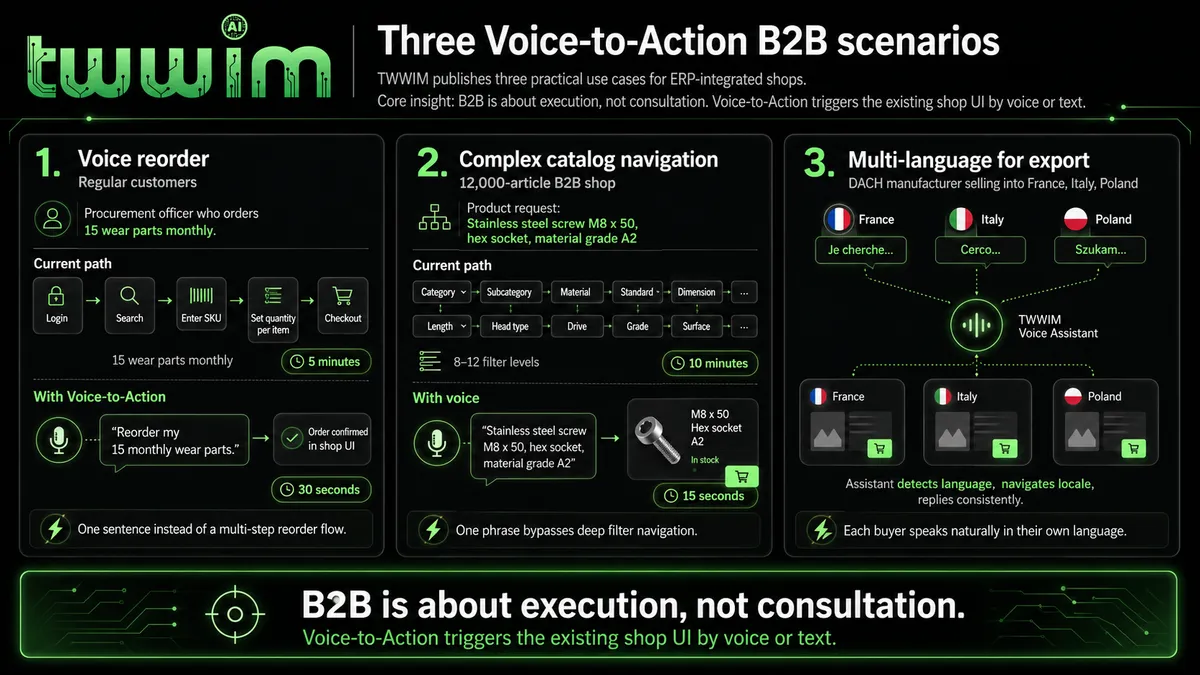
Scenario: A procurement officer at a machinery manufacturer orders the same 15 wear parts every month. Different SKUs, different quantities, repeated week after week.
Current click path: Login, search per item, verify SKU, enter quantity, add to cart. 15 items take 3 to 5 minutes per order - every week, every regular customer.
With the Onsite AI Agent: The logged-in buyer opens the shop and says "Order the standard wear parts from last month again, same quantities." The assistant navigates to the order history, opens the matching order, clicks "Reorder", and adds the items to the cart. 30 seconds instead of 5 minutes. Everything the buyer would do manually, just by voice.
Requirement: The shop offers a reorder feature. Standard in Shopify B2B. The AI automates the existing click path, does not build its own reorder logic.
What is different in B2B: regular customers already know what they need. Consultation is not the bottleneck, speed through the existing UI is. B2C is about discovery, B2B is about execution.
Use Case 2: Complex catalog navigation
Scenario: B2B shop with 12,000 articles in industrial supplies or MRO. A buyer searches for a stainless steel screw M8 by 50 with hex socket, material grade A2.
Current click path: Filter tree with 8 to 12 levels. The buyer works through categories or tries full-text search. Hits imprecise, filter labels unclear, technical specs hard to map. 5 to 10 minutes search per article is not uncommon.
With the Onsite AI Agent: The buyer states "Stainless steel screw M8 by 50, A2, hex socket." The voice agent translates the natural-language input into the matching filter combination (material: stainless steel A2, diameter: M8, length: 50mm, drive: hex socket). Three to five hits displayed directly. 15 seconds instead of 10 minutes.
Requirement: The shop has structured filters and well-maintained product metafields. The AI maps vocabulary to existing filter combinations, does not invent new filters.
What is different in B2B: B2B buyers think in specifications, not adjectives. Where B2C searches for "cheap" or "modern", B2B buyers search for material grades, standards, tolerances. Voice hits this precise vocabulary faster than clicking through a filter tree.
Use Case 3: Multi-language for export
Scenario: A DACH manufacturer sells B2B into France, Italy, Poland. Same shop, but each buyer expects their language - including in technical datasheets.
Current click path: Language switcher in the footer, hard to find. Translations often inconsistent, especially in product descriptions and technical specifications. The buyer loses trust, calls sales, or leaves the shop.
With the Onsite AI Agent: The Polish buyer speaks to the assistant in Polish. The AI detects the language, navigates within the Polish locale setup, and responds consistently in Polish. If the buyer is logged in and the shop saves the language preference in the profile, the next session is immediately Polish.
Requirement: The shop already offers the target languages - multilingual versions via WPML, Polylang, Shopify Markets, or similar setups. The voice agent navigates to the matching language version and ensures consistent answers. It does not translate missing content itself.
What is different in B2B: international B2B buyers order in large volumes. If communication is unclear, they go elsewhere. A mistranslated spec turns into a complaint, a return, or a lost account.
What needs to be in place
Two factors determine how well an Onsite AI Agent performs in a shop:
- Existing UI functionality. TWWIM can only trigger what the shop itself can do. No reorder button means no voice reorder. No structured filters means no voice filtering.
- Data quality. Maintained catalog, clear product copy, consistent categories, curated knowledge base.
ERP-integrated shops have a double advantage: clean master data from the ERP plus mature B2B features in the frontend such as reorder, account pricing, or quote builder. TWWIM integrates via the shop's standard interfaces. The ERP itself stays unchanged.
Why it matters now
In B2B, tooling has traditionally been slow. Buyers work with software that is often in their way: many-click ordering, slow filters, language gaps in export business. An Onsite AI Agent shortens those paths, because it knows what is possible in the shop and how to do it.
This is not AI as consultation. This is AI as execution. Regular customers, international buyers, and procurement teams notice the difference immediately - in seconds rather than minutes.
TWWIM is live as a Shopify app, a WooCommerce plugin, and a JavaScript snippet for any framework. If your shop is ERP-integrated and you want to know which of these three use cases would pay off first: twwim.ai or find me on LinkedIn.
Dmitri Botezat builds TWWIM, an AI assistant that lives on merchant sites and helps shoppers find what they're looking for - by voice, by text, on the page itself. Self-hosted AI, no third parties in the data path. twwim.ai