TWWIM AI is only as good as what you feed it
An AI agent is only as good as its sources. How to build your product data, knowledge base and page so TWWIM navigates, answers and acts correctly.
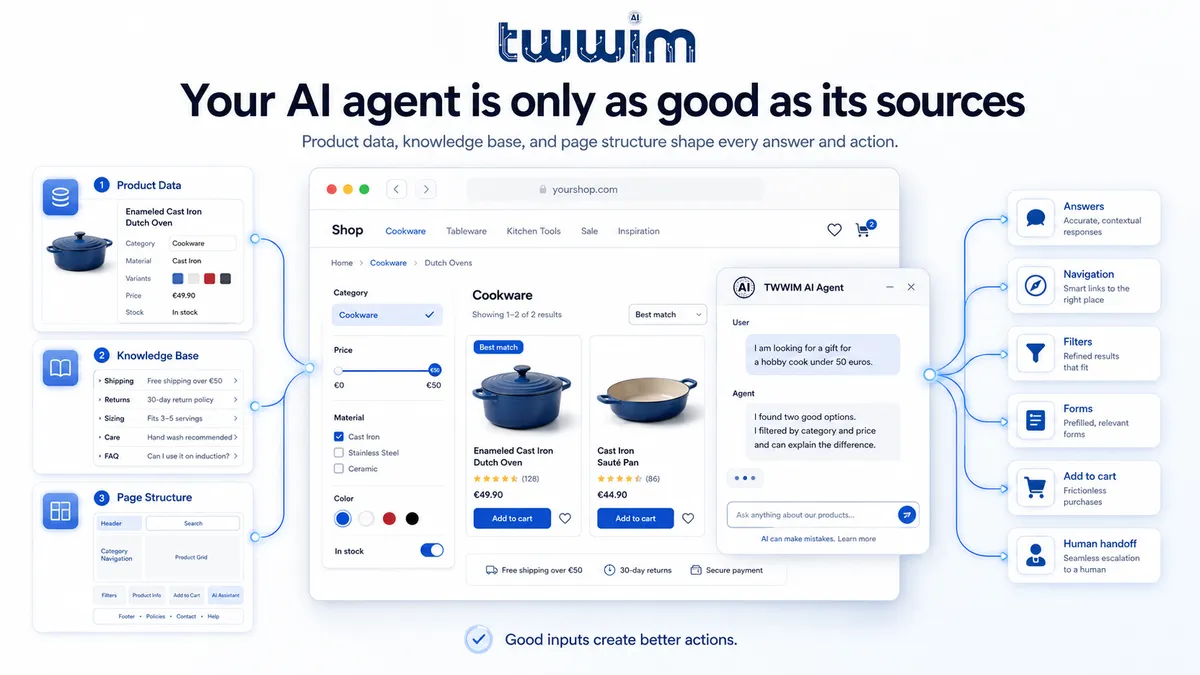
An AI agent on your website is not magic. It is only as good as what you feed it.
I build TWWIM, an OnSite AI Agent that sits on the page and acts for the visitor: sets filters, navigates, adds to cart, fills out forms. And the agent does not draw on a single source. It draws on several, and each one is a lever you control. When one is weak, you hear it in the answers. Garbage in, garbage out applies here three times over.
Three sources decide how good your agent gets: your product data, your knowledge base and your page itself. The good news: what makes the agent good also makes your site better for humans and for Google.
Your product data
For product answers, the agent does not read your page HTML. It reads your catalog directly. It syncs with your shop, whether Shopify, WooCommerce or JTL, and works with titles, attributes, variants and prices exactly as they are stored there.
So clean, complete product data in your shop is half the battle. A product with a clear title, maintained attributes and the right category can be found, compared and filtered by the agent. A product whose most important property lives only in the body of the description is practically invisible to a filter question. Work on your product data pays off twice: better filters for humans, better answers from the agent.
Your knowledge base
Everything that is not in the product catalog comes from the knowledge you upload. Shipping, returns, sizing, policies, FAQ, B2B terms. The agent breaks this knowledge into individual pieces and pulls the relevant ones for each question.
What matters: upload the documents that answer the real questions your customers ask, not the glossy PDF. Write in clear, self-contained pieces, one topic per section. Be specific, "shipping takes 2 to 4 business days" beats "shipping is handled promptly". And keep it current, because outdated knowledge becomes a wrong answer that sounds confident.
You do not have to guess at this. In the Knowledge Playground you ask the agent exactly the questions your customers ask, see for every answer which pieces it used, and fix the weak ones on the spot. That way you close the gap before a customer finds it.
Your page
The page is where the agent moves and acts. One principle rules here: simplicity over complexity. The clearer a page, the better the agent understands it, and the better the human does too.
Three postulates make a page readable to the agent:
- Simplicity over complexity. A tidy page with real, labeled controls is unambiguous. A mess of unlabeled icons and nested layers hides the intent, from the agent and from the visitor alike.
- Link structure is navigation. The agent finds its way through your links. Clear, descriptive link text and a clean structure are its map. "Shipping and returns" is a signpost, "click here" is not.
- One page, one job. A page focused on a single purpose is unmistakable. The agent knows what it is for. A page that wants to do five things at once confuses it, and the visitor too.
Follow this, and your site becomes fully understandable to the AI. It can navigate, click, filter and fill out forms, and it uses the text on the page as an additional source for answers. None of this is exotic. These are exactly the principles of good UX and good SEO.
What the agent can then do
When all three sources are right, the behavior changes noticeably. The visitor says what they want, and the agent goes to the right place instead of dumping a list of hits. It answers correctly, from the right bucket: product questions from the catalog, policy questions from the knowledge base. In the visitor's language. And it acts: sets filters, fills the form, adds to cart.
An example. Someone types: I am looking for a gift for a hobby cook under 50 euros. On a clean setup, the agent filters to the category, applies the price cap and explains two options with the right attributes. Without that setup, all it can do is apologize and point at the search box.
And when no source has the answer, the agent says so and hands over to a human on your team instead of inventing something. An honest "let me quickly check that" is worth more than a made-up delivery time.
Good for the agent, good for everyone
The point behind all of it: this is not special work the AI forces on you. Clean product data, clear knowledge, a simple and focused site. That is the same hygiene that serves your visitors and your ranking. The agent just makes the cost of neglecting it visible.
If you run TWWIM, or plan to, start with the sources. Data, knowledge, page. The agent does the rest.
Dmitri Botezat builds TWWIM, an OnSite AI Agent that lives on websites and helps visitors find and do what they want. By voice, by text, right on the page. Self-hosted AI in the EU, no customer data to third parties. More at twwim.ai.