The Universal Commerce Protocol Gives AI Agents Your Store. Is That What You Wanted?
The Universal Commerce Protocol sounds like progress. But when customers never visit your site, who owns the relationship?
In January, Google and Shopify stood on stage at NRF and announced the Universal Commerce Protocol. Open standard. 20+ partners. Walmart, Target, Stripe, Visa, Mastercard on board. The pitch: a single protocol that lets any AI agent discover products, fill carts, and complete checkout across any merchant.
I've spent the last few weeks reading the spec, the blog posts, the developer docs, and the LinkedIn celebrations. And I keep coming back to one question that nobody on stage seemed interested in asking.
What exactly does the merchant get out of this?
What UCP actually does
Let me be specific. UCP creates a standardized interface between AI agents (Gemini, ChatGPT, Copilot, and whatever comes next) and commerce backends. The agent can query products, check availability, apply discounts, handle loyalty programs, process payments, and manage orders. All through a single protocol. REST, MCP, A2A - pick your transport.
The merchant exposes their catalog and checkout capabilities. The agent consumes them. The customer sits inside Google's Gemini or Microsoft's Copilot and says "find me running shoes under 120 euros, waterproof, ship to Germany." The agent queries multiple merchants, presents options, and completes the purchase. The customer never opens a browser tab with your store URL.
Technically, this is well-built. Google has a history of building solid protocols. The architecture is modular, extensible, and the documentation is better than most open standards I've seen.
But good engineering doesn't automatically mean good outcomes for everyone involved.
What the merchant keeps
The official messaging is clear: the merchant remains the "Merchant of Record." You process the payment. You fulfill the order. You handle returns. Your terms apply. Google made a point of emphasizing this at NRF, and Shopify repeated it.
You also keep your product data. UCP reads from your system - it doesn't copy your catalog into Google's infrastructure. Your shop system stays the source of truth.
These are real advantages, and I don't want to dismiss them. For small merchants who struggle with visibility, being discoverable through Gemini and ChatGPT could matter.
What the merchant loses
Here's the part that gets less attention.
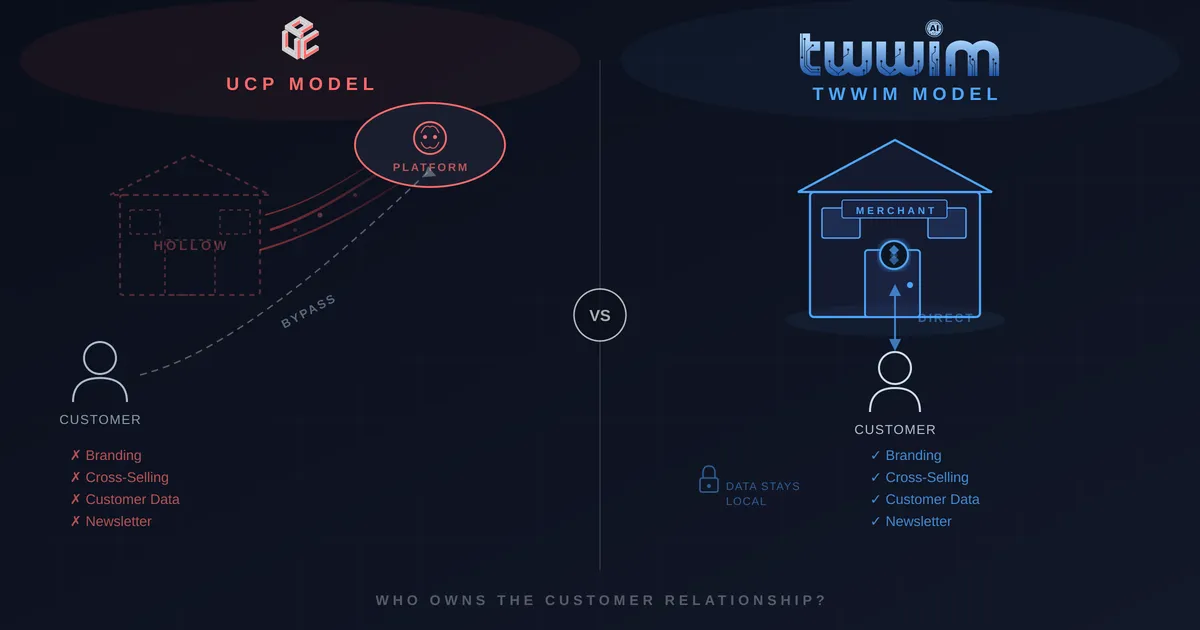
When a customer buys through an AI agent, they never see your website. That sounds like a minor detail until you think about what your website actually does beyond displaying products.
Your homepage tells a brand story. Your product pages show lifestyle photos, size guides, customer reviews, comparison tables. Your checkout flow offers newsletter signups, gift wrapping, related products, warranty upsells. Your post-purchase page invites the customer to follow you on social media or join a loyalty program.
None of that exists in a Gemini chat window.
The customer asks for running shoes. The agent returns a product card with a title, price, image, and a "buy" button. Maybe a discount code gets applied. The transaction completes. The customer never learned your brand name, never saw your other products, never signed up for anything.
You processed a sale. But you didn't gain a customer.
That's a meaningful difference for any business that thinks beyond single transactions. And in my experience, the businesses that survive long-term are exactly those that think beyond single transactions.
The Google Shopping pattern
This isn't the first time Google has offered merchants reach in exchange for relationship. Google Shopping started with free product listings. Then came paid ads. Then comparison shopping. At each step, merchants got more visibility and less connection to the customer.
The pattern: Google inserts itself between the customer and the merchant, captures the discovery moment, and charges for the privilege. The merchant gets volume. Google gets the data and the customer's attention.
UCP follows the same pattern, except more deeply integrated. With Google Shopping, the click at least landed on your site. With UCP, the entire transaction happens inside Google's ecosystem. The customer doesn't leave Gemini. Google gets the search query, the product comparison, the purchase intent, and the conversion data. The merchant gets an order.
When 20+ of the largest companies in retail and payments align behind a protocol this fast, it's worth asking whose problem this is solving. Integration complexity is a real issue - nobody enjoys building bespoke connections to every AI surface. But "we'll handle all the complexity for you" has historically been the opening line of every platform that eventually became a gatekeeper.
What I'm building instead
I think about this problem from the opposite direction.
I build an AI companion that lives on the merchant's website. Not a chatbot in the corner - a system that understands the page, knows the full product catalog, learns the site structure over time, and helps customers find what they need through voice and text. Inside the page, not above it.
When a customer says "I need something waterproof for hiking," the website responds. Products get highlighted. The page scrolls to the right section. The AI knows what's in stock, what ships to the customer's country, what other customers with similar questions ended up buying. All of that knowledge stays with the merchant. Nothing goes to Google, nothing feeds a third-party model.
The customer is on your site. They see your brand. They discover your other products. They might sign up for your newsletter. When they come back next month, they come to your URL, not to Gemini.
This is a fundamentally different approach. UCP gives your product data to external agents and hopes they'll send you orders. My approach gives your website its own intelligence and lets you keep the customer relationship.
The honest question
I'll be transparent about something. I'm not sure where UCP and tools like mine end up relative to each other.
There's a scenario where UCP becomes the standard for external discovery - how new customers find you through AI agents - and on-site AI companions handle the experience once they're on your site. These could be complementary. My tool could even use UCP's cart and checkout capabilities while keeping the experience on the merchant's domain.
But there's another scenario where UCP makes the storefront functionally irrelevant. If 60% of purchases happen inside AI interfaces, investing in your website becomes hard to justify. And that means tools that make websites smarter lose their market too.
I don't know which scenario wins. I suspect the answer depends on how aggressively Google pushes checkout inside Gemini and how quickly merchants realize what they're giving up.
What I do know: building your entire commerce strategy around a protocol controlled by the company that also controls the discovery layer is a risk. Merchants should be walking into this with open eyes, not just celebrating the press release.
Dmitri Botezat builds TWWIM, an AI companion that lives on merchant websites and helps customers find what they need - by voice, by text, inside the page. Self-hosted AI, no third-party data pipeline. twwim.ai