What your shop AI actually does: Statistics and Visitor Intelligence
Per McKinsey, only 6 percent of organizations see measurable returns from AI. Statistics and Visitor Intelligence give TWWIM merchants visibility into AI performance and customer demand.
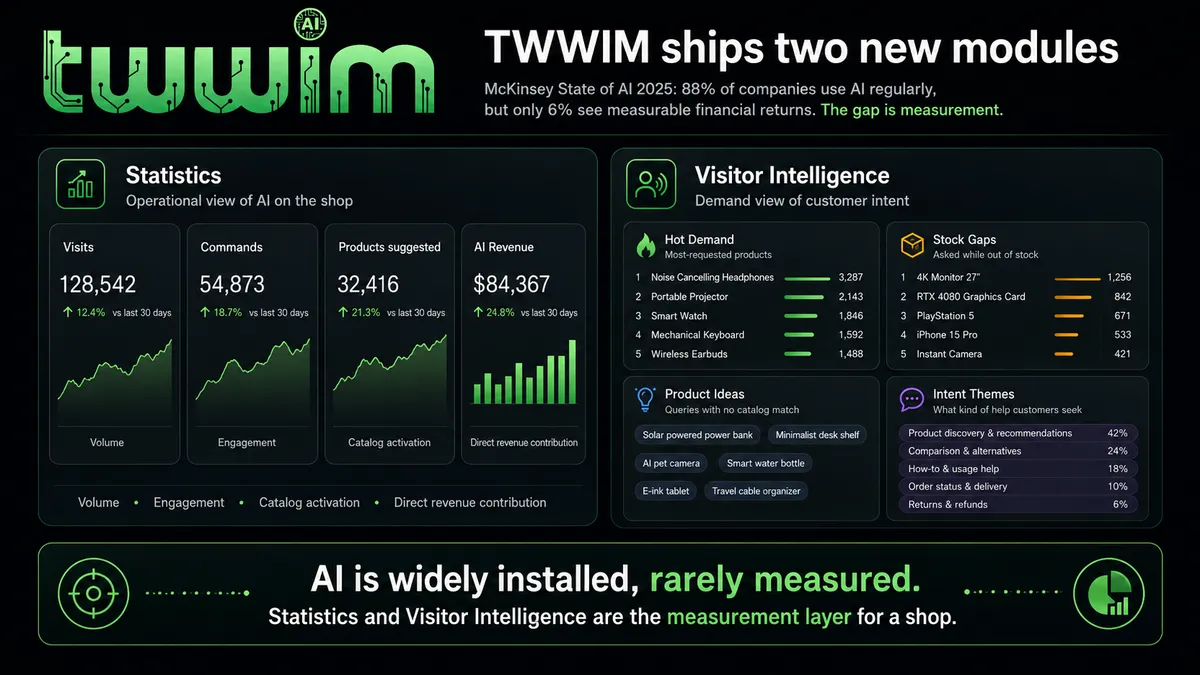
Per McKinsey State of AI 2025, only about 6 percent of organizations see measurable financial returns from AI. With 88 percent using AI regularly, the message is clear: installing AI is solved, making it measurably contribute to the business is not.
Two new TWWIM modules address this directly: Statistics and Visitor Intelligence. Statistics answers what the AI is doing on your shop. Visitor Intelligence shows what your customers are actually searching for. Both work on the same AI interaction data but answer different business questions.
Statistics: AI performance at a glance
Statistics answers four core questions about your AI investment.
Visits show reach. How many shop visitors actually land on a page with AI active? A low number means customers are not seeing the widget. That is a visibility problem, not an AI problem.
Commands show engagement. How many of those visitors actually interact with the AI? Visits high and Commands low signals a UX problem. The widget is there but is not being adopted.
Products suggested shows catalog activation. Is the AI recommending products purposefully or just answering generic questions? If this number stays low, the AI is in consultation mode rather than sales mode.
AI Revenue shows direct revenue contribution. Sales that completed after AI interaction. This is the answer to the question McKinsey raises: does this AI investment pay for itself?
Under the cards, a trend line provides time context. Sudden spike on a particular day? Visible. Weekly trend up or down? Same.
An additional error breakdown helps debug failed commands. Relevant for daily operations only when error rates climb.
Visitor Intelligence: customer demand in real time
Statistics shows volume. Visitor Intelligence shows content. Every AI request is a datapoint about what your customers are actually looking for, in their own words. This data is not collected systematically anywhere else, not Google Analytics, not your shop platform.
Hot Demand shows the most-requested products. This list is your priority list for inventory, marketing, and pricing. Top three probably not surprising. Position four and beyond often are.
Stock Gaps quantifies lost revenue. Products customers asked about while out of stock. Each row represents a specific customer with purchase intent who could not buy. Directly preventable revenue loss.
Product Ideas is your sourcing intelligence. Queries that matched nothing in your catalog. Customers literally articulating what they would buy if you carried it. Ranked by demand.
Intent Themes diagnoses your storefront. If a large share of requests is about sizing, your size chart is hard to find. If many requests are about shipping status, your order tracking UX is unclear. The AI is not the problem, it just shows where the actual problem is.
Translating data into decisions
The individual numbers matter less than the connections between them. Typical business questions Statistics and Visitor Intelligence answer together:
- AI Revenue flat despite traffic? Either engagement is too low (Visits high, Commands low) or conversion is (Commands high, Revenue low). For the second case, Intent Themes shows where the friction sits.
- Stock Gaps growing week over week? Restock those first. You are serving active demand, not hypothetical.
- Product Ideas list getting longer? A concrete catalog plan with demand evidence behind it. You will not find better sourcing input anywhere else.
- Intent Themes distribution shifts toward shipping or returns? Better AI does not fix that. Clearer shop copy or faster processes does.
The AI runs the conversations. Statistics and Visitor Intelligence translate what those conversations mean for your business.
Why now
I have been building TWWIM as a solo founder since October 2025. Statistics and Visitor Intelligence could have shipped earlier in half the quality. Instead I waited until they hold up in practice. Four cards and four categories feel right after this time. Six would have been noise, three would have been a gap.
Both modules are live in the TWWIM dashboard starting today. For merchants not yet using TWWIM: twwim.ai. Questions or feedback, find me on LinkedIn.
Dmitri Botezat builds TWWIM, an AI assistant that lives on merchant sites and helps shoppers find what they're looking for - by voice, by text, on the page itself. Self-hosted AI, no third parties in the data path. twwim.ai