Why 70% of Shopping Carts Get Abandoned - and What You Can Do Before It Happens
Around 70% of shopping carts are never completed. The standard response is recovery campaigns. But not every abandonment has the same cause - and not every lost customer can be brought back by email. Here's which abandonments can be prevented before they happen.
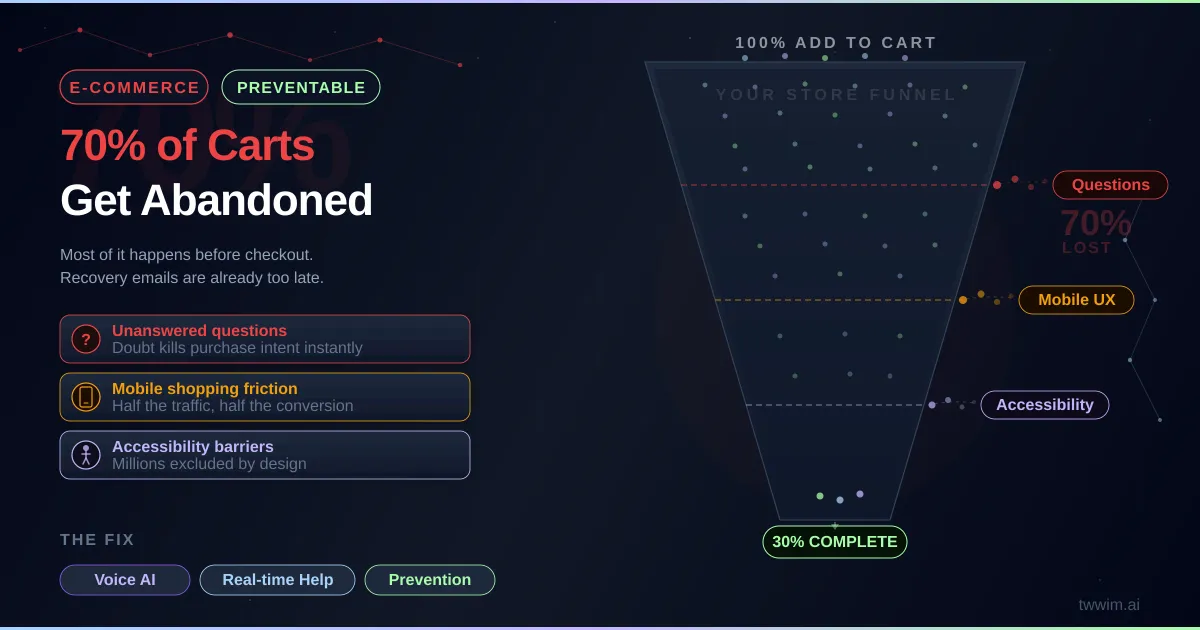
Around 70% of all shopping carts are never completed. It's one of the most cited statistics in e-commerce - and one of the most misunderstood.
The typical response: better recovery sequences. Abandoned cart emails, retargeting campaigns, SMS reminders. All useful tools. But they intervene at a point that is already too late.
If you want to understand how to actually reduce cart abandonment, you first need to understand why it happens. And there isn't one reason - there are several. Most of them are preventable, before anyone closes the tab.
Reason 1: Questions go unanswered
This is the most common reason that gets the least attention. Someone lands on a product page with genuine interest - but a question stays open. Which size fits? Is this compatible with my device? What happens if it doesn't work out?
When in doubt, people don't buy. The visitor leaves - not because they didn't want the product, but because the uncertainty outweighed the impulse to purchase.
These abandonments are solvable. But only in the moment the question arises. A recovery email an hour later doesn't answer the question. It just reminds someone of a purchase where the uncertainty is still there.
Reason 2: Mobile shopping is too much work
More than half of e-commerce traffic now comes from mobile devices. But conversion rates on mobile are significantly lower than on desktop - in many shops less than half.
That's not because people don't want to buy on their phones. It's because navigation, product search, and checkout on small screens are genuinely difficult. Tapping through categories, setting filters, comparing variants - what works acceptably on a desktop browser becomes a test of patience on mobile.
Many people simply abandon because the effort is greater than the motivation. The purchase intent was real. The experience wasn't.
Whoever addresses this - and makes mobile shopping radically simpler - eliminates an entire category of abandonments before they happen.
Reason 3: Accessibility is not a niche issue
In Germany, the Barrierefreiheitsstarkungsgesetz (BFSG) applies to online shops from June 2025. Similar requirements are rolling out across the EU. But beyond legal compliance: a substantial portion of potential customers struggle with online shopping in ways that have nothing to do with purchase intent.
People with visual impairments. People with motor difficulties who find mouse-based navigation painful. Older users who get lost in complex shop structures. They abandon - not because the product is wrong, but because access is too hard.
Voice control solves this barrier directly. Someone who can say what they're looking for, instead of clicking through it, suddenly has access to a shop that was previously unusable for them. That's inclusion - and it shows up as measurable conversions from a segment that was silently abandoning before.
What's left for recovery
Once these three categories are addressed - unanswered questions, poor mobile experience, missing accessibility - what remains is a cleaner set of abandonment cases. People who left for genuinely unavoidable reasons. The phone rang. The battery died. The meeting started.
These people are the real target audience for recovery campaigns. Their purchase intent was genuine, their interruption was circumstantial. A well-timed reminder works here precisely because the reason they left had nothing to do with the product or the shop.
The distinction matters: recovery tools work with a fixed percentage of people who come back. If you first reduce friction abandonments, mobile abandonments, and accessibility abandonments, the composition of your recovery audience changes. The share of people for whom follow-up actually works goes up.
What this means in practice
TWWIM AI works before the abandonment. Not as a replacement for recovery - as a filter in front of it.
Customers can speak during the session: "I'm looking for a waterproof hiking backpack under 80 euros." The assistant understands the request, acts on the page, and returns the right result - without navigation, without filtering, without typing. It works on desktop, it works on mobile, and it's accessible to people with impairments in a way that click-based navigation simply isn't.
The math is straightforward: fewer friction abandonments mean more completed purchases. Not as recovered customers - as customers who never had to leave in the first place.
Curious what this looks like on your shop? twwim.ai - or reach out directly.
Grüsse aus Aachen, Dmitri Botezat, Founder TWWIM AI