Navigation: from sentence to the right page
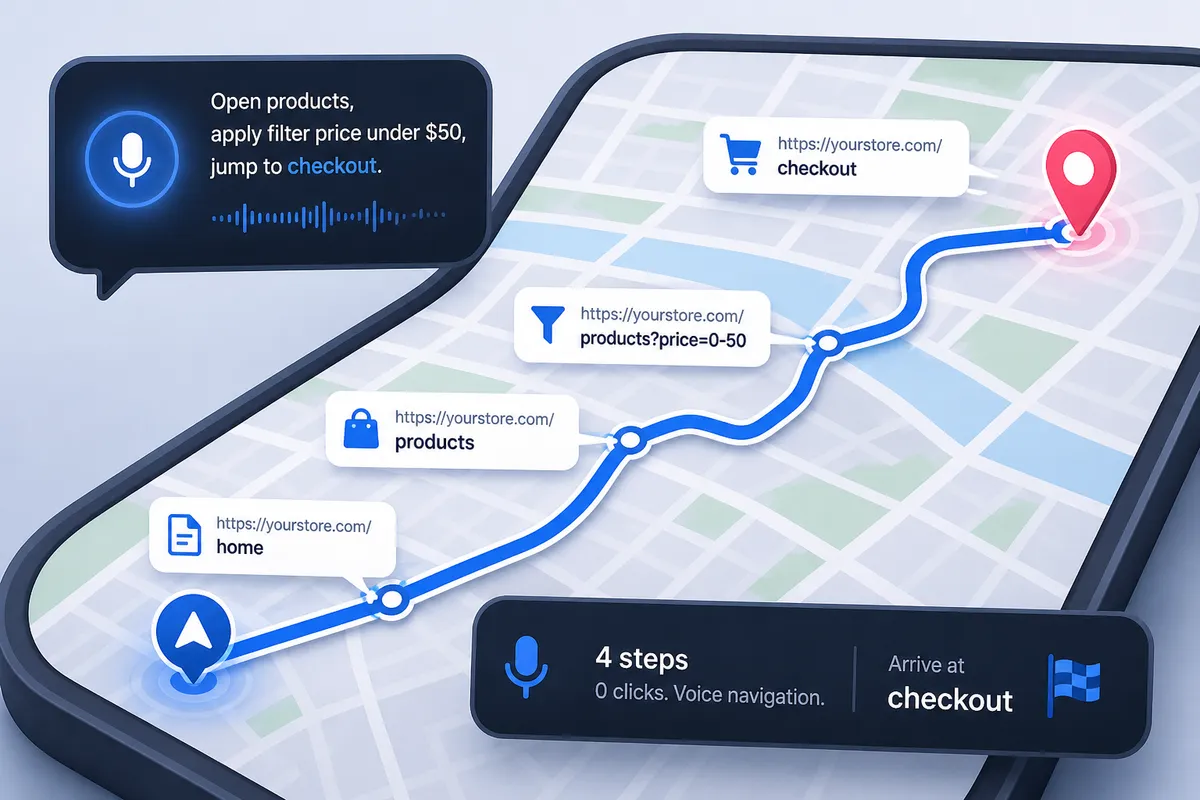
Most mobile visitors leave because of a click count, not because of your products. TWWIM lets them say what they want in one sentence and arrive at the right page on your shop, using your existing filters and categories.
Part one of three. Part two is about on-page actions. Part three is about how the assistant knows your shop.
Most of your mobile visitors leave because of a click count, not because of your products.
A visitor opens your shop on a phone. They want red running shoes under 80 euros. They have to find the menu. Find the right category. Scroll through products. Find the filter button. Open the size filter. Scroll for their size. Apply. Open the color filter. Tap "red". Apply. Open the price filter. Drag a slider on a tiny screen.
Mobile traffic is 60 to 70 percent of e-commerce visits. It converts at roughly one third of desktop. There are many reasons why, but the click count is one of the biggest. Visitors give up before they reach what they wanted to buy.
This is the problem TWWIM was built to solve first.
What changes for the visitor
The visitor opens the assistant on your shop. They speak or type one sentence: "show me red running shoes under 80 euros, size 42." That is it. The assistant goes to the right category, applies the filters that exist on your shop, and scrolls to the result. The visitor watches it happen on your page, in your design, with your filters. There is no chat window taking over the screen.
If the result is wrong, the visitor refines: "only the waterproof ones." The assistant adjusts. The visitor never has to learn the structure of your shop. They describe the goal, the page goes there.
This is the part of the product I think about as "the plugin replaces hands." The visitor does not click through your menus and filters. The assistant does, on their behalf, in real time.
Why it matters most on mobile
On desktop, your filter UI works. It has space. The visitor can hover, click, see results immediately. Voice helps, but the difference is incremental.
On mobile, your filter UI is the bottleneck. Filters live behind a button, behind a modal, behind a slider sized for a thumb. Every visitor who closes your shop on the third tap is a conversion you lost. Voice navigation collapses six taps into one sentence. That is the point.
On the test shops I built this against, a typical filter combination on mobile takes 8 to 12 taps to construct. The same combination by voice takes 3 to 5 seconds, and the visitor sees the result without ever opening a single menu.
What it is not
It is not a search bar. Search matches keywords against product names. The assistant uses your filters and categories the way a human would. If your shop has a "waterproof" tag, the assistant uses it. If you organize running shoes by terrain, the assistant respects that.
The assistant also does not push products at the visitor. It takes them where they asked to go. When a recommendation surfaces, it comes from your shop's own merchandising, not from a model deciding what the visitor should want.
And it does not take over your design. Visitors stay on your pages. The filters that get applied are yours. The categories that open are yours. If you redesign your shop tomorrow, the assistant keeps working, because it works through what you have, not around it.
How it composes with the rest
Navigation is the entry point. Once the visitor is on the right page, actions take over: add to cart, change quantity, move to checkout. That is the second piece. Both pieces stand on the assistant's memory of your shop: what products exist, what filters exist, what your pages say. That is the third.
If you want to see this work, try the demo with a complex filter combination. Or install on your own storefront via the WordPress plugin or Shopify app, and watch what your visitors actually ask for in the first week. The questions tend to be more specific than your filter UI assumes.
Dmitri Botezat builds TWWIM, an AI assistant that lives on merchant sites and helps shoppers find what they're looking for - by voice, by text, on the page itself. Self-hosted AI, no third parties in the data path. twwim.ai