Memory: what the assistant actually knows about your shop
Most chatbots do not know your shop. They have a system prompt mentioning your brand. TWWIM has memory built from your documents, your live catalog, and your pages - always current, hosted in the EU, with no third parties in the data path.
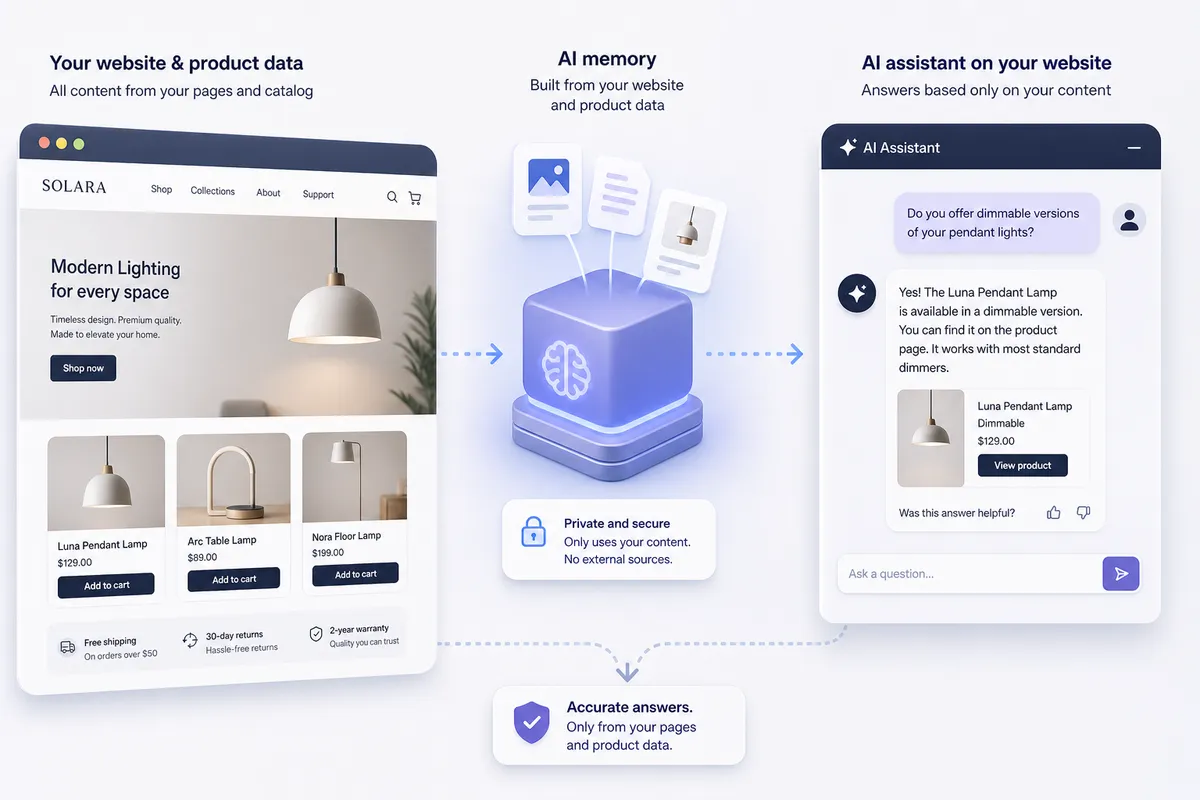
Part three of three. Part one was about navigation. Part two was about on-page actions.
Most chatbots do not know your shop. They have a system prompt mentioning your brand. They have a vague training run from before your last product launch. They have a search box that updates once a week. None of that is knowledge of your shop.
The assistant in TWWIM has memory, and the memory is the reason the first two parts of this trilogy work. Without it, the assistant guesses. With it, the assistant acts.
This article is about what is in that memory, where it comes from, and how it stays current.
Three sources, in this priority
The assistant builds its picture of your shop from three places, in order of trust.
At the top sits anything you upload yourself in the dashboard. Return policy, shipping terms, FAQ texts, sizing guides, product care notes. These are documents you control directly. If you upload a return policy, the assistant treats your wording as authoritative on that topic. You wrote them on purpose, so the assistant trusts them most.
Next is your product catalog, synced from your shop. This is not a one-time import. When you connect TWWIM to Shopify or to WooCommerce, the plugin runs a full sync of your current catalog, then keeps in step with everything that happens after. New product, price change, stock update, removal: all of it is reflected on the assistant's side immediately. Your visitors never see a stale price or a sold-out product as available.
Then comes the live content of your pages. Whatever else exists on your site that is not in the dashboard and not in your catalog: your About page, your blog, your contact details. The assistant uses these to fill in answers when neither your documents nor your catalog cover the question.
The hierarchy matters because content sometimes contradicts itself across a shop. A product detail page might mention a 14-day return window in passing, while your formal return policy says 30 days. The assistant uses the document you uploaded, because that is the canonical version. You write the rules, the assistant follows them.
Why this is different from training data
Most AI products that talk about a specific business were trained or fine-tuned on a snapshot of that business at some point in the past. That is not memory of your shop. That is a frozen picture of what your shop looked like the day someone copied your data.
A frozen picture goes stale fast. Prices change. Products sell out. New collections launch. Return policies get updated. A model trained on last quarter's catalog will tell a visitor about products you discontinued. It will quote prices you raised. It will recommend out-of-stock items as available.
TWWIM does not freeze. The catalog connection updates immediately on every change in your shop. The documents you upload take effect as soon as you save. There is no retraining cycle, no deployment window, no version mismatch between what your shop says and what the assistant says.
How memory makes navigation and actions possible
Navigation works because the assistant knows what filters exist on your shop, what categories the products live under, and where the relevant pages are. When a visitor says "show me red running shoes under 80 euros," the assistant does not invent filters. It uses yours.
Actions work because the assistant knows what your products actually are right now. When a visitor says "add two of the blue mug to my cart," the assistant knows whether the blue mug is in stock, what variant it is in your shop, and what the current price is. It is not guessing from old information.
The two earlier parts of this trilogy assume memory is solid. This part is about why it is.
What stays separate
Each shop's memory is its own. Your products, your documents, your pages do not get mixed with another merchant's data. There is no shared model that pools information across shops. The assistant your visitors talk to on your shop knows only your shop.
The infrastructure runs in the EU, on hardware I operate. There are no third-party AI services in the data path. Your visitors' questions and your shop's content do not get sent to external providers for processing. This matters for GDPR, and it matters for merchants who do not want their catalog and customer questions sitting in a US training pipeline.
How to see it
Install the WordPress plugin or the Shopify app and connect your shop. Within minutes, the assistant has your full catalog. After that, every change you make in your shop reaches the assistant immediately. Open the demo widget on your own pages and ask it about a product you just edited. The answer reflects what you wrote, not a stale copy.
That is what memory means here. Not a system prompt, not a training run, not a weekly index update. The assistant knows your shop the way you do, because you and the assistant are looking at the same source.
Dmitri Botezat builds TWWIM, an AI assistant that lives on merchant sites and helps shoppers find what they're looking for - by voice, by text, on the page itself. Self-hosted AI, no third parties in the data path. twwim.ai