European Accessibility Act: What Web Agencies Owe Their Clients
The European Accessibility Act has been in effect since June 2025. Most online shops still have not adapted. The uncomfortable part: it is not just shop owners at risk - the agencies that built those shops may be liable too.
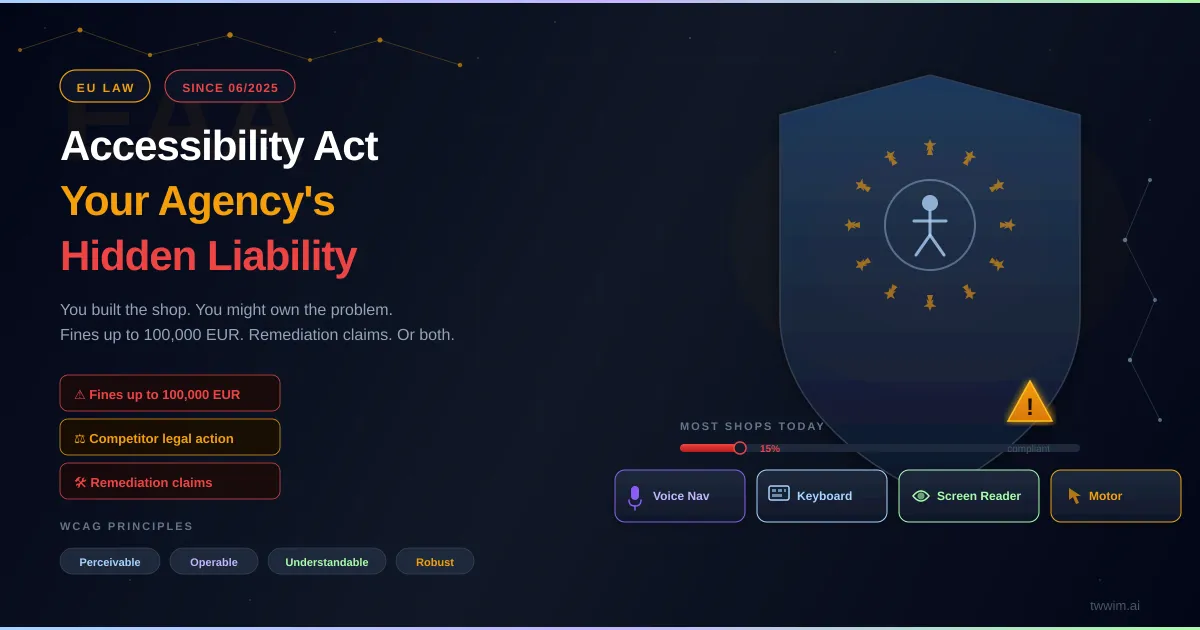
The European Accessibility Act has been in effect since June 2025. Nine months later, most online shops still haven't done a thing. And here's what makes this uncomfortable: it's not just the shop owners who are exposed. The agencies that built those shops are too.
If you built it, you might own the problem
When an agency builds an online shop, the contract is typically a work-for-hire agreement. The deliverable: a functional, fit-for-purpose website. Since June 2025, accessibility in B2C e-commerce is part of what "fit for purpose" means under EU law.
A shop that doesn't meet accessibility requirements can be considered a defective deliverable. Even if the contract never mentioned accessibility. The legal standard asks whether the work is suitable for its ordinary use and meets the quality that's typical for work of the same kind. Accessibility is increasingly seen as part of that baseline.
I'm saying this as a software developer with 15 years of experience, not as a lawyer. But the legal analyses I've read all point in the same direction.
Fines, lawsuits, or both
The consequences for shop owners are spelled out clearly: fines up to 100,000 euros, competitor-initiated legal action, and in extreme cases, an order to take the shop offline. That's all in the law.
For agencies, the picture is different but no less serious. If a client discovers their shop isn't compliant and the agency delivered the project recently, there's a clear path to claims for remediation. Or damages. The agency delivered work that doesn't meet current legal requirements.
Will courts enforce this aggressively? Hard to say. But the legal foundation is there, and the first cases are a matter of time.
What the law actually requires
The European Accessibility Act targets compliance with WCAG guidelines. Perceivable, operable, understandable, robust - those are the four principles. In practice that means screen reader compatibility, keyboard navigation, sufficient contrast, alternative text for images.
But it goes further. Accessibility means people with a wide range of limitations can use a website. Motor impairments, visual disabilities, cognitive challenges. Most agencies think of accessibility as alt texts and color contrast. That's a start, but it's nowhere near enough.
Voice navigation is an aspect almost no one talks about. For people with motor impairments, the ability to navigate a shop by speaking is not a nice-to-have. It's exactly the kind of accessibility the law has in mind. Someone who can't use a mouse precisely, someone with tremor or limited fine motor skills - voice commands solve a real problem for them.
If you're an agency looking for a solution that goes beyond the minimum and is easy to integrate, voice-based navigation systems are worth a serious look. The technology exists, and integration is much simpler than most people assume.
Who does this law actually apply to?
Quick clarification, because there's a lot of half-knowledge floating around. The EAA applies to services in electronic commerce aimed at consumers. B2C. Pure B2B operations are exempt. But watch out: the moment a consumer can enter into any kind of contract on your website - including booking an appointment or creating an account - the law applies.
Micro-enterprises with fewer than ten employees and under two million euros in annual revenue are exempt for services. But most agency clients running professional online shops are above that threshold. And even if they aren't, the exemption applies to the shop operator, not necessarily to the agency as the creator of the work.
Three ways agencies are handling this
In my experience, agencies fall into three camps. The first group ignores the whole thing and hopes enforcement won't kick in yet. That works for now. Long-term, it's a liability that compounds.
The second group adds a paragraph to their contracts shifting accessibility responsibility to the client. Legally possible, but it doesn't solve the problem. It just moves it - and damages the client relationship when things go wrong.
The third group treats the EAA as an opportunity. Accessibility becomes a standard part of every project, and the agency positions itself as a partner that doesn't just build attractive shops but compliant ones. That's the approach with staying power - and it opens up a new revenue stream along the way.
Accessibility isn't a one-time project. It's an ongoing process with regular audits, updates, and extensions. For agencies, that means recurring contracts instead of one-off billing.
The blind spot
What surprised me as a developer: most discussions about the EAA focus on visual accessibility. Screen readers, contrast, font sizes. All important, no question.
But accessibility has more dimensions. Someone with tremor can't control a mouse precisely. Someone with limited fine motor skills struggles with small buttons and complex forms. Someone with cognitive limitations may not understand the navigation intuitively.
Voice navigation addresses several of these problems at once. And it's comfortable for all users - not just people with disabilities. That makes it a rare solution that improves compliance and user experience at the same time.
What I'd tell agencies right now
Be proactive. Reach out to your existing clients before the first legal letter arrives. If you bring this up now, you're an advisor. If you wait, you're doing damage control.
Build accessibility into your standard process. Not as an add-on, not as an optional package. As part of every B2C project. The legal basis is clear enough to justify that.
And look beyond alt texts and contrast ratios. Voice navigation, keyboard controls, cognitive simplification - the spectrum is wide, and the clients who take this seriously will choose the agencies that can cover all of it.
If you want to see how voice-based navigation works for your client projects in practice, reach out directly. I'm happy to walk you through a real integration.
Dmitri Botezat is building TWWIM, an AI assistant that lives on merchant websites and helps customers find what they're looking for - by voice, by text, right inside the page. Self-hosted AI, no third parties in the data path. twwim.ai