The Extended Funnel: What Agentic Commerce Really Means for Your Store
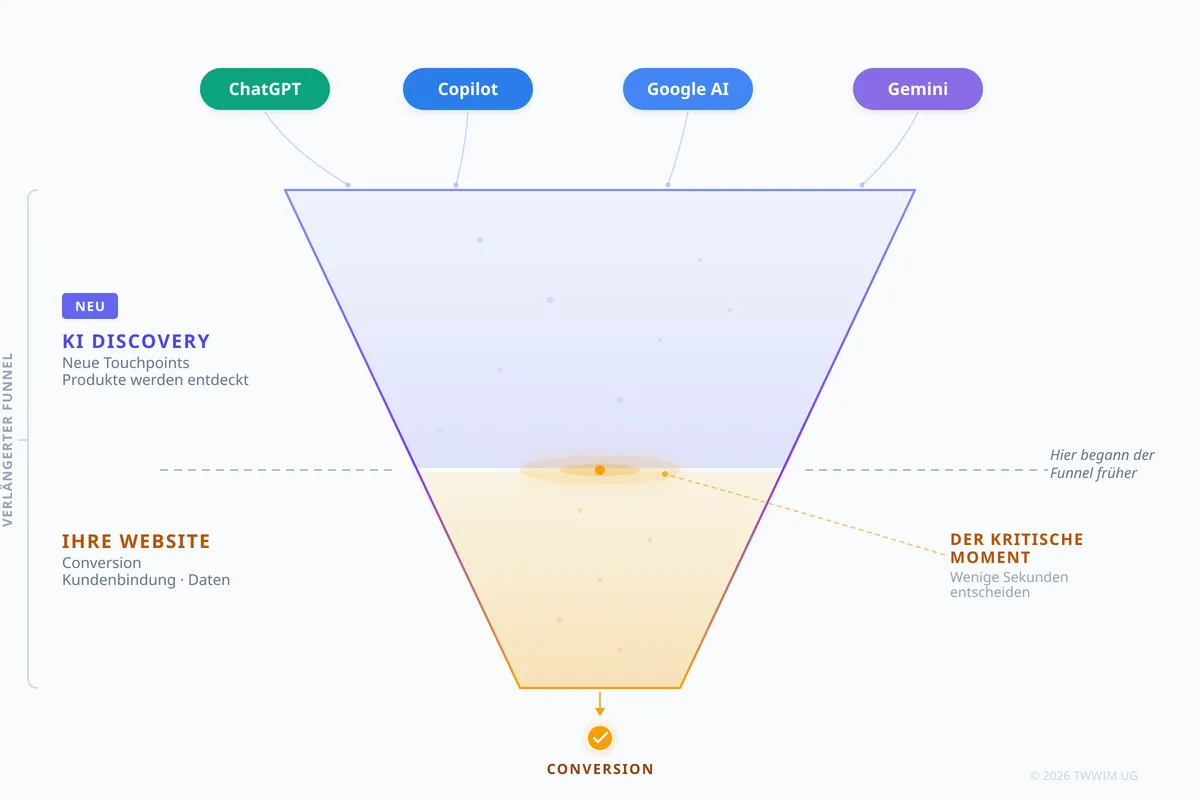
OpenAI's Instant Checkout lasted six months and reached roughly 30 merchants before being shut down. Shopify's answer: Agentic Storefronts, no transaction fees, purchase on the merchant's own website. The funnel hasn't dissolved - it has extended. And it ends on your site.
In September 2025, OpenAI launched Instant Checkout. Customers would buy directly inside ChatGPT, without ever visiting a merchant's website. The fee: 4% per transaction, plus Stripe's standard processing of around 2.9%. On a 100-euro order, the merchant paid roughly 7.20 euros in platform costs before their own payment stack even started.
The industry responded accordingly. "Websites are dying," people said. "Customers will soon buy exclusively through AI agents." The direct connection between merchant and customer - the owned website, the owned relationship - seemed to be retreating.
Six months later, reality looks different.
What Actually Happened
Instant Checkout failed. Not as a concept, but in execution. Merchant onboarding proved complex, the checkout was error-prone, and product selection stayed limited. After six months, roughly 30 Shopify merchants were reachable through Instant Checkout - out of the millions announced. Walmart made around 200,000 products available. Etsy participated. But the system wasn't reliable enough.
OpenAI drew the conclusion. Instant Checkout is being shut down. Instead, OpenAI is now working with retailers to build dedicated apps that route users to the merchant's own website to complete a purchase. On desktop, ChatGPT opens a new browser tab on the merchant's site directly.
Today, March 24, 2026, Shopify responded. Agentic Storefronts are now available to all Shopify merchants. Products become discoverable in ChatGPT, Microsoft Copilot, Google AI Mode, and the Gemini app. The purchase happens through the merchant's browser, on their own website. No transaction fees beyond standard processing rates. Merchants remain the merchant of record - they keep the customer relationship and the data.
What Changed - and What Didn't
Discovery is moving into AI channels. That's real, and it's accelerating. When someone asks ChatGPT for "running shoes for wet weather under 120 euros," products surface. That's a touchpoint that didn't exist two years ago.
But the purchase still happens on the merchant's website. The funnel hasn't dissolved. It has extended.
That sounds like a small technical shift. It isn't. Because what it means is this: a customer who discovered through ChatGPT, compared through Copilot, and got the final push from Google AI Mode - that customer lands on your website at the end. With expectations already formed. With a specific product in mind. With the intent to buy.
And then they decide in a few seconds whether they stay.
The Critical Moment
I have been building a voice assistant that runs directly on websites for months now. What I have learned: the moment a visitor arrives and doesn't immediately find what they're looking for is the most expensive moment in e-commerce. Not cart abandonment - that's the consequence. The moment before it, when orientation is missing and frustration starts to build.
AI-powered discovery doesn't shrink this moment. It amplifies it. A customer who was qualified across three AI channels carries higher expectations than someone who clicked a Google ad. They know what they want. They have less patience.
Merchants who spent six months waiting for agentic commerce to arrive while neglecting their own website now face a specific problem: more qualified traffic, the same conversion rate. That means more customers lost at the finish line.
What Merchants Need to Do Now
Setting up Agentic Storefronts is the easy part. Shopify makes it accessible and the onboarding is straightforward.
The hard part is the website itself. Can a visitor find what they're looking for? Can they navigate without thinking? Does the product search handle unusual or conversational queries? Is the website accessible - not just for compliance reasons, but because an assistant that can't serve all users isn't a good assistant?
AI channels own discovery. The website owns conversion. This division of labor is new. But it doesn't mean the website becomes less important. It means the website becomes more important than it has ever been - because it's the last and only touchpoint the merchant fully controls.
The extended funnel ends with you. The question is whether you're ready.
Dmitri Botezat is building TWWIM, an AI assistant that lives on merchant websites and helps customers find what they're looking for - by voice, by text, inside the page. Self-hosted AI, no third parties in the data path. twwim.ai