The difference between answering and acting
Most AI helpers just answer and leave the next step to the visitor. On the difference between answering and acting right there on the page.
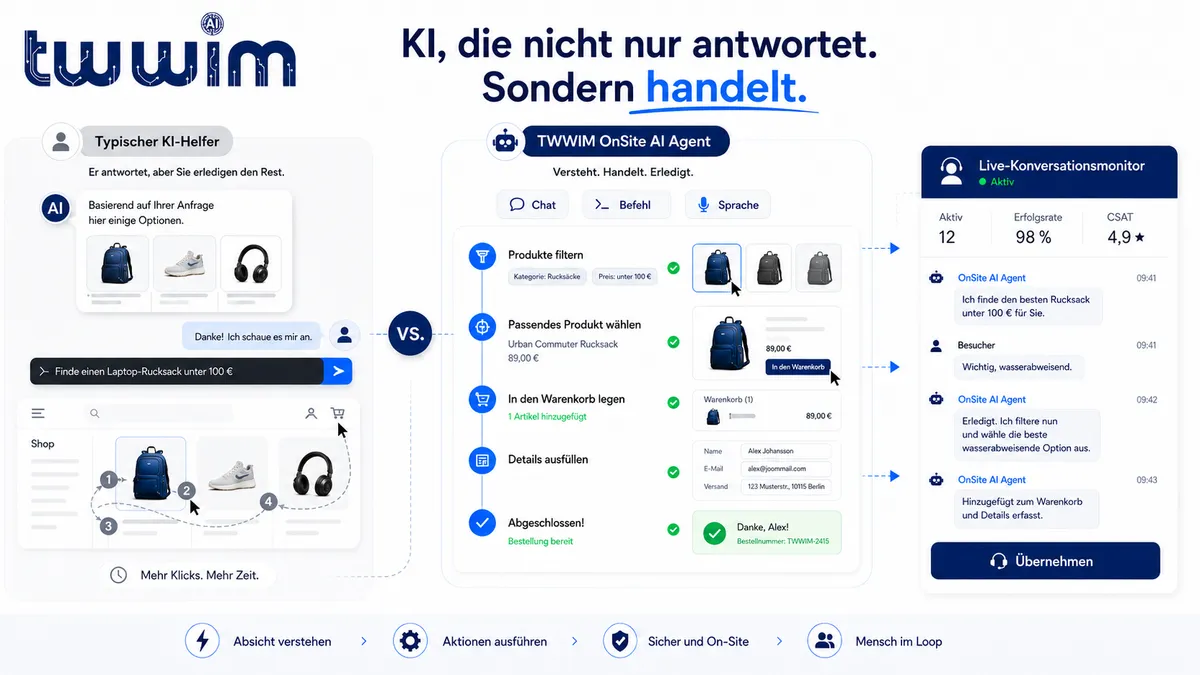
Ask a typical AI helper on a website which product fits you, and you get a decent answer. And then you sit there, with that answer, and click your own way through the shop anyway. That small moment kept nagging at me for months, because the answer is right there, it is even correct, and still nothing happens. The work the helper was meant to take off your hands lands right back with the visitor.
What most people mean by "chat"
A chat window is almost expected these days. You type a question, you get an answer, often a link to the right page on top, and for plenty of cases that is fine. It just moves the work around: the visitor now has an answer and a link, and from there he is on his own again. Open the page, set the filter, find the form, fill in the fields. The window did the talking, the clicking in the end was still on the human. Answers are not the problem. The real question is why the conversation stops at exactly the point where it would start to help.
Three ways to talk to the page
TWWIM is an OnSite AI Agent that sits right on the page. You can reach it in three ways, whichever suits the moment:
Type in the chat window, the familiar way.
A short text command, when you know exactly what you want.
Just speak, when your hands are busy elsewhere.
Which one you pick is taste, because behind all three is the same agent. And it does not stop at the answer but takes the next step on the page itself. The window itself is almost beside the point, since the interesting part is what comes after the question.
Four moments, one pattern
It makes the most sense in a real moment. Someone is looking for a gift in a shop but only has a vague idea. The old way meant clicking through twelve categories and hoping. Here he just says what it is about, and the agent filters the catalog and drops the right item into the cart. Or the last question before buying, the one that so often sends people away, like whether the material is okay for someone with allergies. The agent pulls the answer from the stored product info, the visitor stays, the purchase goes through.
B2B looks different and comes down to the same thing. A regular customer wants his monthly reorder, speaks it in, and the agent fills the cart with the order he always places. Minutes of clicking turn into one sentence. Or the classic in technical trade, an M8 stainless steel screw in a specific length. Instead of fighting through filter lists, the customer says the spec, and the part is there.
Not only shops
For a while I thought of TWWIM mainly as a shop thing, and that was too narrow. The agent runs through a small JS snippet, and that goes onto any website, not only into a shop. A consulting or company site has no cart, but the same gap: someone is after the right service, cannot find the right subpage, and is gone before he ever saw the contact form. The agent brings him to the right page and fills the form with what was already said in the conversation. Same idea, different type of page.
Where the agent gets its knowledge
An agent that really acts must not guess. Put the wrong item in the cart once and the trust is gone faster than it was built. Its knowledge therefore feeds from three sources, all of them in the operator's own hands:
The page itself, the one it stands on and reads along with.
The product sync, which pulls the item data straight through the shop interfaces instead of scraping it from the page HTML.
The files you upload as a knowledge base, a data sheet or an FAQ, which you can test in peace in the Knowledge Playground beforehand.
It does not sound like much, but it is exactly why the answers stay tied to the real data instead of being made up.
Watching along when it matters
The more an agent acts on its own, the more something people tend to overlook starts to matter: being able to see what it is actually doing. An agent that quietly handles things on the page must not be a black box for the operator. So every conversation runs along live in the dashboard, and the full history stays available afterwards. If a conversation gets tricky, or if you would rather look after a particular customer yourself, a human can step in at any time, take the conversation over and carry it to the end. Acting on its own never means acting unwatched here, and stepping in stays possible at any point.
Where the data sits
In the German-speaking market this is not a footnote, it is often the first question in the room. TWWIM runs on servers in the EU, is built for GDPR and for the BFSG, in force since 28 June 2025. I had the EU AI Act in mind from the start, and all of it is built in Aachen.
What I make of it
Next time someone pitches an AI helper for your site, one question is worth asking. Not whether it answers well, but what the visitor still has to do himself afterwards. If the answer is "keep clicking," then not much has really changed. That last stretch, from the answer to the finished job, is what I sit with.
Dmitri Botezat is the founder of TWWIM, an OnSite AI Agent for shops and websites, based in Aachen. More at twwim.ai.