Actions: the assistant changes the page, not just the conversation
The current generation of e-commerce AI is good at talking about your products. It is bad at doing anything with them. TWWIM closes that gap by acting on the page, in your shop's UI, with your design - while the customer relationship stays with you.
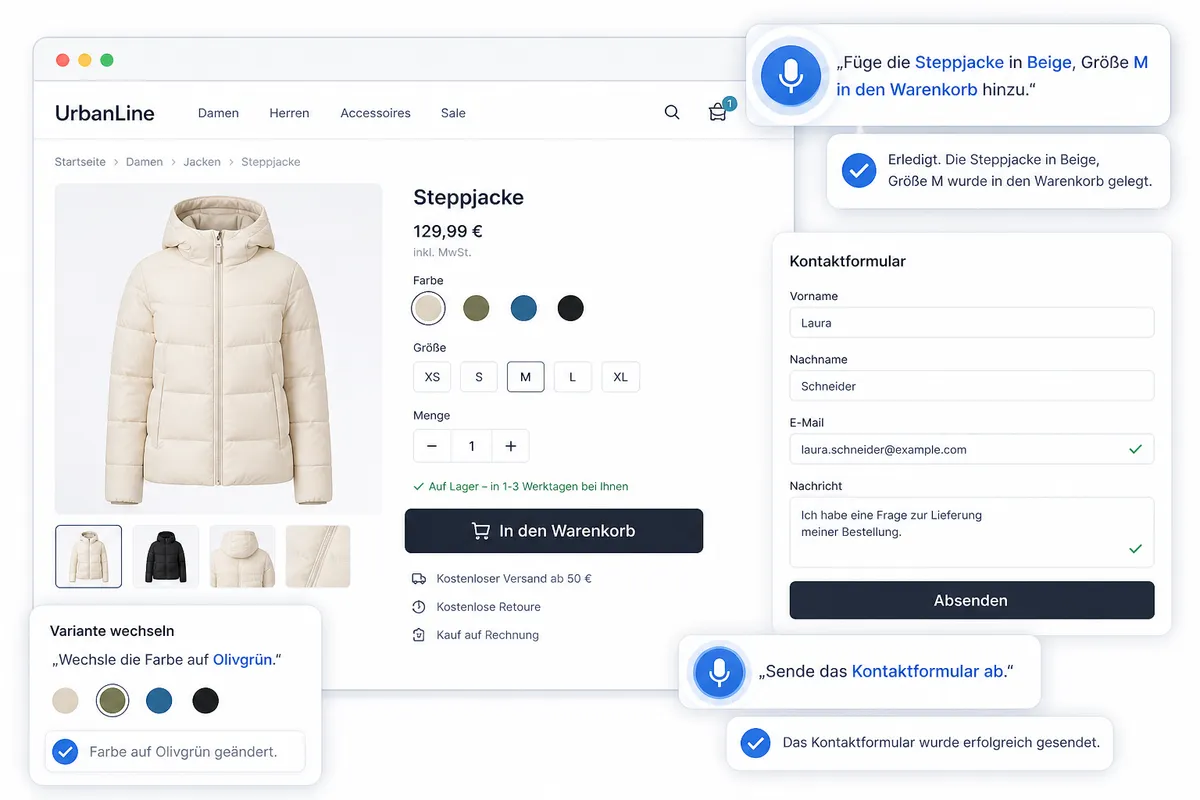
Part two of three. Part one was about navigation. Part three is about how the assistant knows your shop.
The current generation of e-commerce AI is good at talking about your products. It is bad at doing anything with them.
A typical chatbot answers a visitor's question, suggests a product, and then sends the visitor back to the page to do everything themselves. Find the size selector. Pick a quantity. Click add to cart. Open the cart. Apply a code. Go to checkout. Fill the form. Each step is friction. Each step is where some visitors give up.
The chatbot was the wrong shape for this problem from the start. It is in a chat window. The cart is on the page. The two never touch.
What I built instead
When a visitor on your shop says "add two of the blue mug to my cart," the assistant does it. The cart updates. The quantity is two. The variant is blue. The visitor sees this happen on your page, in your cart UI, with your design. They did not navigate to the product detail page, did not pick the variant manually, did not click the quantity selector twice. The assistant did all of that on their behalf.
The same pattern works for the rest of the buying flow. "Apply my code SPRING10" - applied. "Go to checkout" - the page changes. "Use my saved address" - the form fills. The assistant is not a parallel system trying to mimic your shop. It is a layer on top of your shop that uses what you already built.
The two-agent distinction
There are two kinds of AI agents being built right now in commerce, and they are very different products.
The first kind buys for the visitor on external surfaces. The visitor talks to an AI on a generic platform, the AI checks out somewhere else, and the merchant gets a transaction without ever meeting the customer. The customer relationship lives outside the merchant's site. The brand interaction happens elsewhere. The data sits with the platform.
The second kind acts with the visitor on the merchant's own site. The visitor is on your shop. The assistant operates inside your shop. Your design, your funnel, your customer relationship, your data. The visitor still sees your brand at every step. The merchant retains everything that matters: the customer, the analytics, the post-purchase relationship.
TWWIM is the second kind, deliberately. The recent Shopify announcement about agentic storefronts pointed to the same idea: when AI agents enter commerce, the right design has the transaction stay on the merchant's own site, with the merchant keeping the customer.
Why this matters most on mobile
Every additional tap on a phone costs you conversions. A visitor who opens a product, taps the size selector, scrolls through sizes, taps a quantity input, taps to confirm, scrolls to add-to-cart, and then opens the cart has had several chances to abandon. Voice collapses that. "Add the size 42 to my cart, two of them" - done.
The same is true at checkout. Filling a form on a phone is the worst experience in modern commerce. If the assistant can fill it from prior context, the visitor does not type anything at all. That alone is the difference between a checkout that loses visitors at the form and one that does not.
What stays in the visitor's hands
The assistant does not buy without confirmation. It does not send a payment without showing the cart total. It does not commit to a purchase silently. The visitor is always one tap away from cancelling, and one sentence away from changing anything: "remove the second one," "change to size 43," "use the other address." Speed without control would be a worse product, not a better one.
How it composes with the rest
Navigation gets the visitor to the right page. Actions complete what they came for. Both rely on the assistant knowing your shop in detail: what products exist, what they cost right now, which variant is in stock, where checkout lives. That is the third piece, covered next.
To test this on your own catalog, install the WordPress plugin or the Shopify app and try complete purchase intents by voice. Some visitors speak in single sentences: "add the small one in black to my cart and check out with my saved address." That is when the conversion math starts to change.
Dmitri Botezat builds TWWIM, an AI assistant that lives on merchant sites and helps shoppers find what they're looking for - by voice, by text, on the page itself. Self-hosted AI, no third parties in the data path. twwim.ai