Agentic Commerce 2026: Why the Pre-Purchase Experience Is Your Last Chance
Sendcloud's 2026 report names agentic commerce as the top e-commerce trend. When AI agents handle the purchase, merchants lose data, brand visibility, and the customer relationship. But not every purchase will be agentic - and merchants who bring AI onto their own website can keep the customer where the brand lives.
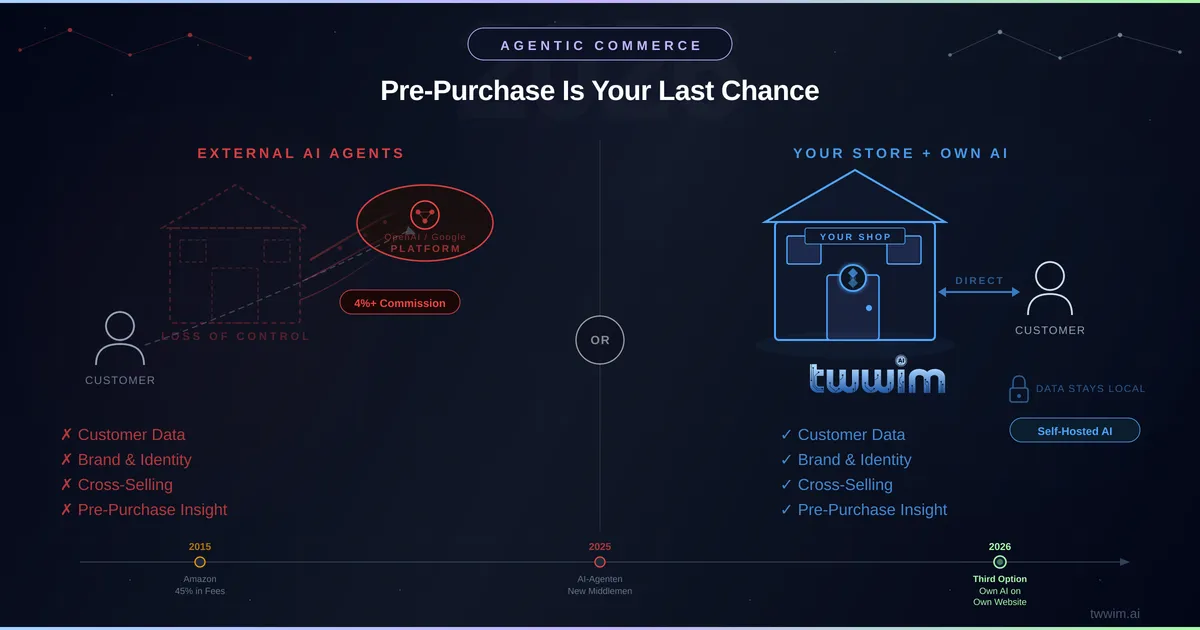
Sendcloud's E-Commerce Trends Report 2026 names agentic commerce as the number one trend. Shopware's co-CEO Stefan Hamann says AI will "no longer be a differentiator, but a prerequisite for participating in digital commerce." The question is no longer whether AI agents will change how people buy. The question is what merchants can do before it's too late.
What Agentic Commerce Means for Merchants
An AI agent researches, compares, negotiates, and purchases - in seconds. The customer never opens a browser, never visits the website, never clicks through categories. They tell their agent what they need, and the agent handles the rest.
For the customer, that's convenient. For the merchant, it's a problem.
When the entire buying process happens inside ChatGPT, Gemini, or another AI system, the merchant receives an order. Nothing more. No data about what the customer searched for. No insight into which alternatives they compared. No understanding of why they chose this product.
All of that now belongs to the platform.
The Post-Purchase Paradox
Iryna Agieieva, Director of Product Management at Mollie, makes a point in the Sendcloud report that stuck with me. When an agent completes the purchase, the first real contact with the human customer happens after payment. Delivery, packaging, support - these become the primary channel for building loyalty.
She's right. And Sendcloud is correct that post-purchase experience matters more than ever in a world with agentic commerce.
But there's an assumption baked into this logic that I think is wrong: that merchants have to surrender the pre-purchase phase without a fight.
Not Every Purchase Will Be Agentic
The agentic commerce narrative treats buying as a single, uniform process. Agent searches, agent compares, agent buys. For commodity products, that's accurate. Printer cartridges, detergent, cables - humans probably won't order these manually in two years.
But e-commerce isn't only commodities.
Someone looking for a birthday gift wants inspiration. Someone comparing a complex product wants to see information on the page and ask questions. Someone browsing a collection wants to feel the brand experience - not read a three-line agent summary.
For these purchases, customers will keep visiting websites. The question is what they find when they get there.
The Amazon Parallel
Ten years ago, merchants listed their products on Amazon because that's where the customers were. The marketplace offered reach, trust, and infrastructure. Five years later, many of those merchants were completely dependent on a channel they didn't control.
Amazon now takes up to 45% of revenue in fees. Merchants lose direct contact with customers. The brand disappears behind the marketplace interface.
Agentic commerce is repeating this pattern with a new channel. Instead of Amazon, the middleman is now OpenAI, Google, or Anthropic. OpenAI already charges roughly 4% commission on transactions through its platform. Google's Universal Commerce Protocol makes products purchasable directly inside Gemini and Google Search - without the customer ever visiting the store.
The difference from Amazon: back then, there was no alternative. The merchant had to join the marketplace because that's where customers were. With AI, there's a choice.
The Third Option
The current discussion presents two alternatives: either you open your products to external AI agents and accept the loss of control, or you stay invisible.
I believe there's a third option. Bring the AI onto your own website.
An AI assistant that works directly on the merchant's site gives customers the same convenience as an external agent: fast answers, precise product discovery, no endless filter menus. But there's a critical difference: the customer stays on the merchant's website. The data stays with the merchant. The brand stays visible. Cross-selling and upselling happen where they belong - while the customer is still deciding, not after they unbox.
If you've built a brand and don't want to hand your customer relationship to a platform, this is an option worth serious consideration.
What AI Agents Actually Prioritize
The Sendcloud report makes an important point: AI agents don't respond to brand storytelling. They prioritize structured data, clear policies, reliable delivery windows, and low-risk returns.
For merchants taking agentic commerce seriously, this means product data must be machine-readable. Prices, availability, delivery times, return conditions - everything needs to be structured and current.
But here's the thing: an AI assistant on your own website needs the same data. Clean product data isn't an argument for or against external agents. It's the foundation for both. Merchants who have their data in order can serve external agents and run their own assistant.
Merchants who don't have their data in order have a bigger problem than agentic commerce.
What Merchants Should Do Now
The recommendation isn't to ignore external agents. For commodity products and transactional purchases, they'll be an important channel. Shopify's UCP integration, the partnerships between Etsy, Target, and ChatGPT - these aren't experiments anymore. This is infrastructure.
But no merchant should abandon their own website. Quite the opposite. The website needs to get better. Faster product discovery, more intuitive navigation, accessibility compliance, and yes - an AI assistant that keeps the customer where the brand lives.
I've been building exactly this approach for over a year. A voice and text assistant that works directly on the merchant's website. By voice or text, within the page. No external chat window, no third-party data processing, self-hosted AI on European servers.
Whether this is the right answer to agentic commerce remains to be seen. But the question of whether merchants should surrender their pre-purchase experience without a fight answers itself with a clear no.
The Question for 2026
Sendcloud's report closes with this: the market no longer rewards growth alone. It rewards operational maturity.
I agree. And I'd add: operational maturity also means not handing control of the customer relationship to third parties. Not to Amazon. Not to Google. Not to OpenAI.
The merchants who will be strongest in 2026 are those who can do both: serve external agents for transactional purchases, and simultaneously offer an on-site experience that no agent can replicate.
Betting on a single channel is the same mistake merchants made ten years ago.
Dmitri Botezat is building TWWIM, an AI assistant that lives on merchant websites and helps customers find what they're looking for - by voice, by text, within the page. Self-hosted AI, no third-party data processing. twwim.ai